TRAILER: HBO Max has released the first trailer for its upcoming Harry Potter series, titled Harry Potter and the Philosopher’s Stone, and revealed it will debut at Christmas 2026.
There is nothing special about Harry Potter – at least that’s what his Aunt Petunia always says. On his 11th birthday, a letter of admittance to Hogwarts School of Witchcraft and Wizardry opens up a hidden world for Harry: one of fun, friendship and magic. But with this new adventure comes great risk as Harry is forced to face a dangerous enemy from his past.
The series stars Dominic McLaughlin as Harry Potter, Arabella Stanton as Hermione Granger, Alastair Stout as Ron Weasley, John Lithgow as Albus Dumbledore, Janet McTeer as Minerva McGonagall, Paapa Essiedu as Severus Snape and Nick Frost as Rubeus Hagrid.
Also appearing are Rory Wilmot as Neville Longbottom, Lox Pratt as Draco Malfoy, Leo Earley as Seamus Finnigan, Elijah Oshin as Dean Thomas, Tristan Harland as Fred Weasley, Gabriel Harland as George Weasley, Ruari Spooner as Percy Weasley, Alessia Leoni as Parvati Patil, Sienna Moosah as Lavender Brown, Finn Stephens as Vincent Crabbe, William Nash as Gregory Goyle, Warwick Davis as Filius Flitwick and Sirine Saba as Pomona Sprout.
Additional cast includes Daniel Rigby as Vernon Dursley, Bel Powley as Petunia Dursley, Paul Whitehouse as Argus Filch, Johnny Flynn as Lucius Malfoy, Bertie Carvel as Cornelius Fudge, Luke Thallon as Quirinus Quirrell, Katherine Parkinson as Molly Weasley, Amos Kitson as Dudley Dursley, Gracie Cochrane as Ginny Weasley, Richard Durden as Cuthbert Binns, Louise Brealey as Rolanda Hooch, Bríd Brennan as Poppy Pomfrey, Leigh Gill as Griphook and Anton Lesser as Garrick Ollivander.The series, based on JK Rowling’s books, is written and executive produced by Francesca Gardiner. Mark Mylod will executive produce and direct multiple episodes of the series for HBO in association with Brontë Film and TV and Warner Bros Television.
The series is executive produced by Rowling, Neil Blair and Ruth Kenley-Letts of Brontë Film and TV and David Heyman of Heyday Films.
FIRST LOOK: Kit Harington heads the cast of A Tale of Two Cities, a four-part adaptation of Charles Dickens’ novel coming to the BBC in the UK and MGM+ in the US.
Harington stars alongside François Civil and Mirren Mack in the series, which is written by Daniel West (Gunpowder) and directed by Richard Clark (Outlander).
London, 1782. Tensions run high in the war between France and Britain. A young woman, Lucie Manette (Mack) has her life upended when she receives a message from Paris – her father, assumed dead for almost 20 years, may be alive. The messenger – idealistic French emigré, Charles Darnay (Civil) – is arrested and charged with treason. Lucie enlists the help of a brilliant but erratic young lawyer, Sydney Carton (Harington), to free Darnay in the hope he will lead her to Paris to track down her father.
Lucie’s collision with Darnay and Carton unleashes a powerful and complex love triangle. Both men fight to be worthy of her love, and Lucie is torn over which one to choose. Yet neither man – physically so alike, spiritually poles apart – can escape the other. Instead, they find themselves bound together in life and death, through triumphs, tragedies, marriage, and murder.
François Civil as Charles Darnay
Kit Harington as Sydney Carton
François Civil as Charles Darnay and Kit Harington as Sydney Carton
Mirren Mack as Lucie Manette
A Tale of Two Cities is produced by Federation Stories, in coproduction with Federation Studio France and Thriker Films, for MGM+ and the BBC. The executive producers are Polly Williams and Sarah Best for Federation Stories, Léo Becker for Federation Studio France, and Kit Harington and Daniel West for Thriker Films. It is produced by Simon Meyers (I May Destroy You).
The series is distributed by Federation International.
For more than 10 years, DQ has covered the global drama business, shining a light on the shows to watch and the people who bring them to our screens, becoming one of the most trusted sources of information available.
We tell the stories behind the biggest scripted TV series and the people making them.
From interviews with actors and writers to deep dives with directors, showrunners and producers, analysis of the latest trends, and on-set reports, DQ explores the craft of making television drama.
We also highlights numerous other aspects of production, from costume, production and make-up design to casting, location scouts, visual effects and music, to find out how those in the business do what they do, both in front of and behind the camera.
DQ showcases the hottest new shows airing around the world in our monthly Series to Watch articles, as well as highlighting some of the actors, writers and directors with new projects to watch out for in the annual DQ100 — our rundown of some of the most exciting, intriguing and highly anticipated projects airing this year, next year and beyond.
Over the past decade, DQ has built up a loyal audience online and in print that trusts us to celebrate the creativity and craft of the international television industry and serve as a guide to what to watch.
And now we’re asking those readers to become subscribers.
From Tuesday March 24, our content will move behind the paywall, with subscriptions at £7.50 per month or £75 per year.
DQ will also launch soon on Substack, where new content will be simultaneously published to allow subscribers to receive the latest Drama Quarterly stories and newsletters directly in their inbox or via the Substack app or website.
Not everything will go behind a paywall – DQ’s coverage of the latest first-look images and trailers from up-and-coming series will still be accessible to all, so readers can continue to discover Drama Quarterly.
We hope you will come with us on this journey and become one of our valued subscribers for the price of a pint of beer or a glass of wine.
Small Prophets creator Mackenzie Crook teams up with animation directors Ainslie Henderson and Will Anderson to take DQ inside the stop-motion process behind the BBC series, working with puppets and the challenge of blending animation with live action.
Drama Quarterly subscriber content
Subscribe to Drama Quarterly and stay up to date with the shows you love and the stories behind them HERE
FIRST LOOK: Jennifer Garner stars in and executive produces The Five-Star Weekend, an eight-part adaptation of Elin Hilderbrand’s novel launching on Peacock in the US on July 16, 2026.
The story centres on Hollis Shaw (Garner), a famed cook and best selling author known for her delicious recipes, impeccable taste and warm demeanour, who suffers a devastating loss.
Unable to move forward, the death starts to expose the cracks in Hollis’s picture-perfect life — her strained marriage, her complicated relationship with her daughter and her growing pursuit of validation from her fans.
In an effort to overcome grief and find herself again, Hollis gets the idea to host a weekend away at her house on Nantucket with three friends from different stages in her life: her childhood, her 20s, 30s and one surprise fifth star. Set against a luxurious and coastal backdrop, the stars will mature in ways they could never imagine as boundaries are pushed and secrets are exposed.
Regina Hall as Dru-Ann, Jennifer Garner as Hollis, D’Arcy Carden as Brooke, Chloë Sevigny as Tatum (Photo by Greg Gayne/PEACOCK)
Jennifer Garner as Hollis (Photo by Adam Rose/PEACOCK)
Jennifer Garner as Hollis, Chloë Sevigny as Tatum (Photo by Seacia Pavao/PEACOCK)
Jennifer Garner as Hollis (Photo by Seacia Pavao/PEACOCK)
The series also stars D’Arcy Carden, Gemma Chan, Regina Hall, Chloë Sevigny, Harlow Jane and Timothy Olyphant. Additional cast include Rob Huebel, David Denman, Josh Hamilton, West Duchovny, Judy Greer, Tory Devon Smith, Morrison Keddie and Roberta Colindrez.
Bekah Brunstetter is the creator and writer, with Beth Schacter also writing. Minkie Spiro is the director.
The Five Star Weekend is produced by Universal Content Productions. It is executive produced by Sue Naegle and Ali Krug for Dinner Party Productions, Brunstetter, Garner, Hilerbrand, Merri Howard, Schacter and Spiro.
TRAILER: Siobhán Cullen and Paapa Essiedu star in Babies, the story of a resilient couple navigating the heartbreak of pregnancy loss coming to the BBC this month.
Lisa (Cullen) and Stephen (Essiedu) are a couple in their 30s whose dream of becoming parents is tested as they endure multiple miscarriages. While confronting unimaginable grief, their bond shines through with humour, warmth, and unwavering commitment. The newly released trailer offers a first glimpse of their intimate, raw and quietly powerful story.
Charlotte Riley and Jack Bannon also star as Amanda and Dave – a new couple navigating their own challenges and testing their compatibility. Their complex relationship, set against Lisa and Stephen’s ongoing pregnancy journey, begins to expose cracks in Stephen and Dave’s long-standing friendship.
Created, written and directed by Stefan Golaszewski (Mum, Marriage), Babies is produced by Snowed-In Productions and The Money Men Studios, in association with distributor All3Media International.
Golaszewski is also an executive producer alongside Ruth Kenley-Letts (Joan, Strike) for Snowed-In Productions, Neil Blair (Fantastic Beasts, Strike) and Richard Laxton (Joan, Rain Dogs). Danielle Scott-Haughton was the executive producer for the BBC. It is series produced by Lyndsay Robinson (Mum, Marriage), with Kelly Duffell (Aftersun, Black Mirror) as producer.
All episodes of Babies will be available on BBC iPlayer from 6am on Monday, March 30, with the series airing on BBC One from 9pm that night.
A coming-of-age story meets action and mystery in Young Sherlock. Showrunner Matthew Parkhill and executive producer Simon Maxwell discuss the origins of this origin story, working with Guy Ritchie and shining a light on Sherlock’s friendship with his future adversary.
Friends and colleagues for many years, Matthew Parkhill and Simon Maxwell first partnered on 2013 police drama Rogue before teaming up on espionage thriller Deep State.
Running for four seasons on DirecTV in the US and Canada’s The Movie Network and Movie Central, Rogue starred Thandiwe Newton as Grace, an undercover cop whose professional actions have tragic consequences for her personal life. Deep State, which ran for two seasons from 2018-19, introduced Max Easton (Mark Strong), a former MI6 agent brought back into the field as he seeks revenge for his son’s death, only to find himself in the middle of a covert intelligence war in the Middle East.
After two contemporary projects, their latest series together now sees them travel back in time to Victorian England, which serves as the backdrop to Prime Video’s Young Sherlock.
Pitched as an irreverent, action-packed mystery, it charts the origin story of the world’s greatest detective. When a charismatic, youthfully defiant Sherlock Holmes meets none other than James Moriarty, he finds himself dragged into a murder investigation that threatens his liberty.
Sherlock’s first ever case then throws him into the middle of a globe-trotting conspiracy, leading to an explosive showdown that alters the course of his life forever.
The number-one series worldwide on Prime Video following its debut on March 4, the show’s own origin story dates back several years, when Motive Pictures CEO Maxwell was speaking with executive producer Simon Kelton, who had the rights to Andy Lane’s Young Sherlock Holmes novels.
There was also some early interest from director Guy Ritchie, who previously partnered with actors Robert Downey Jr and Jude Law for a pair of blockbuster Sherlock Holmes films.
But when Parkhill joined the project, he found that a 14-year-old Sherlock, as he is in the books, wouldn’t quite work on screen, and so decided to age up the character and have him studying at Oxford University. “It’s about the friendship with Moriarty, the dysfunctional family, the idea of him being in prison and being trouble,” Parkhill tells DQ, “so quite early on, the decision was taken that it’s not an adaptation of the books. The books are great, but [we wanted] to have a different starting point.”
The series was developed with an exec team that includes Dhana Riviera Gilbert, Marc Resteghini, Colin Wilson and Ivan Atkinson. “One of the brilliant foundational bits of creativity and inspiration that Matthew brought to it was the relationship between Sherlock and Moriarty, which is very much the beating heart of the show,” says Maxwell, the former head of international drama at Channel 4.
Hero Fiennes Tiffin plays a rebellious, unformed Sherlock Holmes in Young Sherlock
“We get two origin stories for the price of one, and we’re seeing each of those characters formed on the whetstone of the other, with a friendship that we know is going to turn, one day, into absolute enmity. But in the meantime, we just get to enjoy the Butch-and-Sundance fantastic buddy double act.”
It’s a partnership that is very different from the one Sherlock later shares with Dr John Watson in Arthur Conan Doyle’s original Sherlock novels and the numerous feature films and TV series based on the character.
“Watson will always be a sidekick to him,” Maxwell notes. “He’s a brilliant character but we wanted, very intentionally, to do something that felt completely different to that. We’ve got these two characters who are essentially yin and yang, they’re peers. They can spar with each other until the cows come home, and they are each other’s equal and opposite. There’s an extra thrill in that. There’s so much potential in that relationship.”
“Watson is Robin,” Parkhill says, comparing the character to Batman’s own sidekick. “He’s not an intellectual equal. With Moriarty, the idea is that they’re both Batman. One will turn to the dark and one will turn to the light, but they are intellectual equals.”
As with all prequels, the execs also had to consider how Young Sherlock might eventually bring its characters into line with the versions in Doyle’s books. Their idea, simply, is that for however long the series runs, it will ultimately end where Conan Doyle begins, with his 1887 novel A Study in Scarlet that first introduced Sherlock and Watson.
Dónal Finn (left) plays Moriarty, who is depicted as a close friend of the young Holmes
“Ultimately, the story is one of this incredible friendship that’s going to turn sour,” Parkhill says of Sherlock and Moriarty. “That gave me a sense of liberty or freedom, because it’s quite a weight on your shoulders, taking on this, because so many amazing writers have done it. For my own sanity, I said to myself, ‘If I don’t touch anything after A Study in Scarlet, then that’s our playground.’ It just allows you to breathe a little bit, creatively.”
Notably, one of the show’s writers is Steve Thompson, who also wrote on the hit BBC series Sherlock, which starred Benedict Cumberbatch in the title role. “He was telling me that when they did Sherlock, they mined Conan Doyle for stories,” Parkhill continues. “In our writers room, we consciously didn’t do that. We were like, ‘Well, we’ve got to come up with our own stories,’ but we want to segue into – or set up – certain things that happen later.”
Maxwell describes the protagonist in Young Sherlock as a “man in formation,” with viewers watching a character who is not yet fully formed. That marks the series out as a coming-of-age drama as well as an action-packed mystery show.
“For anyone expecting the fully fledged Sherlock, he’s not that, but there’s so much joy to be found in seeing someone who isn’t perfect,” he says. “Ultimately, his deductive powers are almost at the level of superpowers when he’s ‘Sherlock,’ but they can’t be at this point. You’re seeing the imperfections and you’re seeing each of those imperfections strengthening the character towards becoming the Sherlock we know and love in the future. But there’s definitely a joy in seeing him come into his own.”
When the series opens, Sherlock is behind bars, before being rescued by his brother Mycroft Holmes (Max Irons), so it’s not surprising to hear Parkhill describe him as “a bit of a mess.” He’s also “unfiltered, raw and a bit chaotic. A bit all over the place.” For anyone with preconceived notions of Sherlock, it’s then shocking to find him befriending Moriarty – a character who has traditionally always been portrayed as Sherlock’s arch nemesis but only appears as a main character in one Conan Doyle novel, 1893’s The Adventure of the Final Problem.
Guy Ritchie (right), who directs the first two episodes, on set with actor Colin Firth
Later in the series, viewers also go home with Sherlock and start to discover how his dysfunctional, problematic family have shaped his character.
Portraying Sherlock on screen is Hero Fiennes Tiffin (Harry Potter & the Half-Blood Prince), the nephew of fellow actors Ralph Fiennes and Joseph Fiennes – the latter of whom also appears in Young Sherlock as Silas Holmes.
“The first time I met Hero, he did an audition by Zoom from his holiday in Thailand,” Parkhill remembers. “Even in the first read, he’s obviously got this charm. He brought this sense of wonder, almost. I liken it to an Alice in Wonderland type in the way he looks at the world. And he did that straight away. That just lifted it for me. He brought the whole thing alive, because he wasn’t trying to do a version of Benedict Cumberbatch or a version of Downey Jr. Right away, he brought something into it that just made it his own.”
The cast also includes Natascha McElhone as Cordelia Holmes, Zine Tseng as Princess Gulun Shou’an and Colin Firth as Bucephalus Hodge. But it’s Dónal Finn who threatens to steal the show as Moriarty.
“He didn’t start bad, right? Moriarty didn’t start an arch criminal,” Parkhill says. “And he has the same sort of intellect. He has the same charm. He has the same lack of concern for consequences that Sherlock has. But you see in the show that there are flashes of darkness in him.”
“We’re playing a lot with themes around nature and nurture in the show,” Maxwell says. “The question is around how much of Moriarty is just inherent in Moriarty, and how much of it is because he met Sherlock Holmes. There’s a huge amount of playing with those themes, but also the directions they’re each going in and how they form each other.”
The cast also includes Max Irons and Natascha McElhone
With titles like The Case of the Missing Scrolls, The Case of the Burnt Photograph and The Case of the Unarmed Man, each episode in the series offers a closed-ended mystery – but one that also provides a hook into the next episode and the wider puzzle that plays out across all eight parts.
By design, there are also numerous tonal shifts through the story that lean into Sherlock’s psychology. “So by the mid-season point of season one, when we’re really going back to the trauma zone and delving into the trauma at the heart of the Holmes family, the tone of that is very different to where we start, which is much more light,” Parkhill says. “We want to make sure that across the course of each season, you’re going on a real journey. We’re not ever repeating ourselves. We’re constantly going to surprising places, but also to places that are very personal for Sherlock.”
Not yet an all-out investigator, Sherlock’s interest in taking on cases is also driven by emotion. “Each season we have to figure out how he gets dragged in, and it’s usually as a result of him getting into the shit,” Parkhill adds, “and then that has all these knock-on effects. He’s got to dig himself out of it, which keeps it very personal.”
With Ritchie directing the first two episodes, the series begins with a bang and features some trademark action-packed set pieces, not least a prison yard scrap, a chase around Oxford University and the hold-up of a horse and carriage in the first episode. Contributing to the pace and style of the show is a soundtrack featuring the likes of Black Sabbath, the Cure, Placebo and Radiohead, while Kasabian re-recorded their 2011 song Days Are Forgotten for the title sequence.
Young Sherlock marks the first time Parkhill has worked with Ritchie, and he describes the Snatch and The Gentlemen director as “very much in the moment.” “He loves being on set. That’s where he comes up with all these ideas, working with the actors,” he says. “At first it’s quite intimidating, but then very quickly, it’s quite liberating. Then we tried to keep that process going after Guy left us.” Other directors include Anders Engström, Tricia Brock and Dennie Gordon.
“For me personally, it was intense,” the showrunner continues. “It’s a big show and a lot of moving parts, but it was a hell of an experience.” Filming took place in Oxford, Bristol, Somerset and South Wales, as well as some days in Spain. “It was a hell of a circus to go away and join, and I got very sad when the tent went down at the end of it.”
It’s also the biggest show ever produced by Motive (Get Millie Black, The Woman in the Wall) – and certainly also “the most fun and adventurous,” Maxwell says. Mark Patten served as DOP across seven episodes, providing consistency between directors, with Tom Burton as production designer and Jany Temine as costume designer.
“The cast just made it an absolute joy. There’s something about the energy the cast brought across the board, and we also had that extended into our crew,” he says. “We wanted to make sure that, in terms of the way we put together the directing teams and the HODs, we had as much creative consistency as possible, so it felt like we were making an eight-hour movie. Obviously, Matthew’s very much the creative figurehead across the episodes, but there’s a huge amount of world-class craft that’s been brought to bear from every single member of the team.”
Plans for season two are already afoot, with a writers room completed and many crew keen to return should Prime Video confirm its renewal.
Maxwell adds: “It’s a rare thing making a show that’s four quadrant – it’s there for the whole family. It’s Saturday night at the movies. People felt like they were making something that will hopefully stand the test of time and be enjoyed by audiences all over the world.”
Like that? Watch this! Suggested by AI, selected by DQ
Miss Scarlet & The Duke: In Victorian London, the first female private detective fights for cases and respect, relying on razor-sharp deduction and a combustible partnership with a Scotland Yard inspector.
Young Wallander: A rookie Kurt Wallander witnesses a shocking crime on a Malmö estate, pushing him to confront xenophobia, political extremism and his own ideals.
Veronica Mars: A once-popular teen rebuilds her life as a private investigator in a corrupt California town, solving classmates’ cases while hunting for the truth about her best friend’s murder.
Get Millie Black screenwriter Marlon James joins stars Tamara Lawrance and Joe Dempsie to dissect this five-part crime noir about a former London cop who returns to her Jamaican homeland, revealing their emotional ties to the story and explaining how the series reassesses its setting.
The Woman in the Wall star and executive producer Ruth Wilson joins creator and writer Joe Murtagh to explain how the BBC/Showtime “gothic mystery” puts the spotlight on a dark period of Irish history, revealing surprising character inspirations and the art of sleepwalking on screen.
Mark Strong’s veteran spy comes out of retirement in Deep State, a globetrotting espionage thriller that marks the first original commission for Fox Networks Group Europe & Africa. DQ visited the set.
FIRST LOOK: Ella Purnell returns as wallflower-turned-killer Rhiannon Lewis in the second season of darkly comic thriller Sweetpea, coming soon to Sky in the UK and Starz in the US.
Picking up from the end of season one, Rhiannon is navigating a new promotion, an irresistible rebound and, with a copycat killer threatening to expose her, the kill list is mounting. But she is forced to question whether her perfect ex AJ, was right: is she a monster?
Rish Shah joins the cast as Rhiannon’s romantic interest Gabriel, alongside Tamsin Greig as AJ’s mother Liv. Taj Atwal steps in as Freya, Rhiannon’s formidable new boss at the Carnsham Gazette, while Jenny Walser plays an adoring new friend Daisy.
Returning to the series are Jon Pointing, Jeremy Swift, Leah Harvey, Ingrid Oliver, Nitin Ganatra and Alexandra Dowling.
Sweetpea is adapted from CJ Skuse’s novel of the same name and produced by See-Saw Films and fanboy in association with Sky Studios. Executive producer for fanboy is Patrick Walters (Heartstopper) and executive producers for See-Saw Films are Helen Gregory, Iain Canning and Emile Sherman.
Ella Jones and Ella Purnell are also executive producers, alongside Kirstie Swain. Selina Lim, Emme Hoy, Simon Gillis and Natasha Heliotis are co-executive producers, and Zorana Piggott (Heartstopper) is the series producer.
A team of citizen journalists explore a global conspiracy in The Kollective. Executive producer Femke Wolting tells DQ how it was inspired by a documentary and outlines the international coalition behind the series.
An Amsterdam-based production company with an eye on the international market, Submarine is responsible for scripted projects such as thriller Safe Harbour and genre-bending animated series Undone.
It’s currently in production on Netflix series Toos, a factual drama set in the 1980s that is based on the 1982 kidnapping of Toos van der Valk, the wife of the largest independent hotel chain in the Benelux region. The company is also working with director Kevin Macdonald and screenwriter David Harrower (Lockerbie) on a spy thriller about George Blake, one of the most notorious double agents of the Cold War.
“One strong focus is definitely on English-language drama and international shows not always set in the UK or the US,” Submarine founder and co-CEO Femke Wolting tells DQ. “We like series and films that reflect contemporary themes or issues. We are also very interested in series that are visually, creatively or technically exciting and different. Because we have an in-house animation and FX studio, we like to incorporate those into some of our scripted productions.” Undone, for example, was filmed as a live-action project before it was animated using a technique called rotoscoping.
On its latest series, The Kollective, the team at Submarine faced the creative challenge of how to make the work of a journalism collective visually interesting, as its members are not always in the same place.
The answer was to treat the internet as a shared space where they could come together, with a visual representation of the research they do together appearing on screen to “bring the real and the virtual worlds together in one,” Wolting says. “Because for them, for the characters, they move in and out of that [space]. For them, it’s really all one thing, so we try to represent that in the series as well.”
Inspired by true events, The Kollective follows a group of intrepid citizen journalists who, after a sudden tragedy, find themselves sucked into a globe-spanning web of government lies and corruption. Through a dangerous international investigation, the group exposes the nefarious activities of rogue governments and discovers the human cost of keeping the truth alive.
Femke Wolting
The six-parter’s ensemble cast includes Natascha McElhone, Celine Buckens, Felix Mayr, Gregg Sulkin, Grégory Montel, Karel Roden, Cassiopée Mayance, Martha Canga Antonio, Ralph Amoussou and Gijs Blom. Written by Leonardo Fasoli and Maddalena Ravagli, it is directed by Assaf Bernstein and Randa Chahoud. The creative team also boasts writer Ed Hemming, DOPs Robrecht Heyvaert and Lennert Hillige, and Alexei Tylevich, who designed The Kollective’s on-screen investigations.
The origins of the series can be found in Submarine-produced 2018 documentary Bellingcat, which explores the world of the titular group of citizen investigative journalists breaking stories in an era of fake news and alternative facts.
“While we were filming, I realised the subject of citizen journalism is a really fascinating world,” Wolting says. “These journalists investigate cases using open-source data from the internet, Google Earth but also social media. I loved how it shows how you as an individual can make a difference. Especially in a time that sometimes feels quite bleak, it’s a story that shows how young people are fighting back against fake news and propaganda. So it felt like a world that was relevant and that could also be an exciting international thriller.”
Before moving into film, the exec studied journalism and knew how “super relevant and urgent” the subject of the Bellingcat doc was. But she also recognised that a scripted drama would need to consider a fictional story rather than one based on the real group.
“Bellingcat and most of these other groups, their work is online. They are people working on their computer, investigating, and that doesn’t make a really exciting TV series,” she says. “So when Leonardo Fasoli came on board, he also loved the subject but we all felt it was essential that we made it a series about a fictional group, where the members go out into the real world, just to make it more dramatic and to work as a TV series.”
The Kollective follows a group of citizen journalists uncovering a global conspiracy
It also proved to be a challenge to create a “timeless or still current” story that could stay away from real headlines while being developed several years before it would land on screen. The resulting series opens in the aftermath of a devastating plane crash in the Democratic Republic of Congo that kills everyone on board, including a British journalist who had been investigating the involvement of Russian mercenaries in the region’s valuable coltan mining trade.
When another journalist is murdered, the Kollective’s quest for truth becomes personal, leading them to unravel a major conspiracy that takes them from the streets of Kinshasa to the frozen wilderness of Siberia.
“We had done a lot of research into the coltan mining in Africa, and we felt that those were very interesting worlds to investigate,” Wolting says. “Basically, it’s about how Russia was investing or interfering in coltan mining in Africa for the minerals [needed for] mobile phones, because the coltan is used for chips in computers and mobile phones, which at the time when we started was not a very well-known story. Then over time, it became a much bigger conversation, and it’s now just a much more well-known issue.”
She continues: “The themes of the importance of an independent press, to hold power to account, and the price that must be paid to keep democracy and the truth alive are even more relevant today. Fortunately for us, and unfortunately for the world, I would say it’s more urgent and relevant than it was even a few years ago. These themes and issues are not going to go away anytime soon. Then it was about finding a story that felt relevant and brought the Kollective together and out into the real world to investigate.”
The series brings the digital world of online investigation to life on screen
Mirroring its international collaboration on screen, The Kollective was commissioned by the European Alliance of public broadcasters – Rai in Italy, ZDF in Germany and France Télévisions. Hulu in the US then picked up the series and launched it last year, while it recently debuted on ZDF. It will roll out in Italy and France soon, with A+E Networks handling distribution.
“We had the Alliance as the financiers and we shot in Kenya, Hungary, London, Antwerp and Amsterdam,” Wolting says. “The cast was, of course, international, between the US, the UK, Belgium, the Netherlands, of course, and the Kenyan crew and cast, so that was really wonderful. We did all the visual effects at Submarine. Then a big part of the film crew was a mix of Dutch, Belgian and Hungarian. It was actually wonderful. It was great to work in such an international team.”
Filming in Kenya involved capturing numerous shots following characters through busy streets, as well as a big chase scene. Shots were also completed in a coltan mine, with crew from Hungary, Belgium and the Netherlands brought to the East African country to complement the local crew. “It was quite a challenge to do all that with an international group of people. Some people got sick; all the actors got sick a little bit. So it was definitely exciting and challenging at times,” Wolting says.
The exec believes good infrastructure is key to a successful coproduction, as are banks supporting cashflows from five different countries, understanding the tax implications and different regulations in each country, and working with actors in each location. “There’s just a lot to think about,” she says, “and then coproducing between a couple of broadcasters, a US streamer and a distributor is also about just navigating the creative, working with different broadcasters. The Alliance was great. [They weren’t all giving] different directions, so that was really good. But still, you’re talking with different parties at the same time – that takes some navigating.”
Filmed across Europe and Africa, The Kollective is a globe-trotting thriller
Wolting has also learned that this “hybrid nature” of production – between live action and animated visualisations – significantly affects the way you shoot. “Our background of doing series like Undone and these hybrid productions really helped, because you need to design it from the start before the shoot, not completely like animation but in terms of pre-vis, composing the shots, thinking how that will merge with the live-action shots in a natural way,” she says. “We had to treat that as an integral part of the production. That’s why it was so great that we could do that in-house, [as it gave us] the opportunity to experiment and try out new things.”
With outlines for a second season already in place (nothing is confirmed yet), Wolting adds that making a series relating to current affairs has to work first of all as a thrilling and engaging watch.
“But drama series allow you to connect with people and themes in a different way, to have a deeper understanding of people and the things they go through,” she says. “Besides just wanting to make a great series, I love to shine a light on themes and issues in the real world; to have people think about them and understand them in a different way. I would love that as well with this series.”
Like that? Watch this! Suggested by AI, selected by DQ
Borgen – Power & Glory: A veteran politician and a crusading journalist clash and collaborate when a Greenland oil discovery triggers an international fight over resources, climate and sovereignty, forcing both to choose between truth and realpolitik.
The Newsroom: A cable news team decides to pursue fact-driven reporting over ratings, putting them into direct conflict with corporate interests, partisan politics and the 24-hour outrage economy.
Mr Robot: A brilliant but unstable hacker joins an underground collective plotting to wipe out global consumer debt, triggering corporate counter-attacks, government crackdowns and propaganda wars.
Amazon Prime Video’s animated drama Undone elevates its storytelling with a unique visual style. Femke Wolting, co-founder and MD of producer Submarine, reflects on the creative process behind the series.
Safe Harbor stars Alfie Allen, Martijn Lakemeier and Colm Meaney join creator Mark Williams and producer Femke Wolting to unpack this crime thriller about two friends who cross paths with the Irish mob and become central players in a European drug ring.
Podcasters are television’s new favourite criminal investigators. Jez Scharf and Alex Metcalf, showrunners of Netflix series Bodkin, speak to DQ about this new trend and explain how a trio of podcasters seek to unearth an Irish town’s hidden secrets in the seven-part thriller.
FIRST LOOK: Gugu Mbatha-Raw heads the cast of Possession, a five-part event series set between Bristol and Jamaica coming to Sky and Now in 2026.
Formerly titled Inheritance, the series sees Mbatha-Raw play Claudia, an ambitious young bi‑racial lawyer who travels to Jamaica to challenge an inheritance claim made by a local man, Cudjoe East (Sheldon Shepherd), against Oliver Connaught (Jonny Lee Miller), a wealthy white aristocrat.
But the case takes an unsettling turn when Claudia discovers that the disputed estate is the very place that has haunted her nightmares: Hope Hill, the Connaught family’s former plantation. As Claudia and Oliver dig deeper, they uncover a disturbing link between the plantation’s brutal past and the injustices still shaping the present.
The series also stars Bel Powley as Charlotte, Nadean Rawlins as Mercy, Sean Gilder as Tom McKenzie, Olunike Adeliyi as Patsy Dawkins, Richard Dillane as Eugene Desfrienes, Diveen Henry as Flora, Jack Bandeira as Kenneth Connaught, Shantol Jackson as Sarah, Jeff Crossley as Angelo and Safina Simpson as Betina.
Possession is produced by Snowed-In in association with Sky Studios. The series is based on an original story created by Jefferson Bannis. Executive producers are Ruth Kenley-Letts, Jenny van der Lande, Neil Blair, Karla Crome, Storm Saulter, Sam Hoyle, Serena Thompson, Gugu Mbatha-Raw and Jonny Lee Miller. The development producer is Roxanne Harvey and the series producer is Kate Ogborn.
NBCUniversal Global TV Distribution is handling international sales of the series.
Gone writer George Kay and director Richard Laxton discuss their collaboration on this ITV psychological drama, how it was inspired by a real police detective and working with stars Eve Myles and David Morrissey to create a six-part cat-and-mouse thriller.
Drama Quarterly subscriber content
Subscribe to Drama Quarterly and stay up to date with the shows you love and the stories behind them HERE
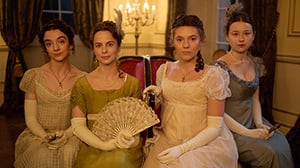
From the shadows of Pride & Prejudice, Mary Bennet takes centre stage in BBC drama The Other Bennet Sister. DQ speaks to star Ella Bruccoleri about playing the overlooked character, brushing up on Jane Austen and stepping into a leading role for the first time.
Growing up, Ella Bruccoleri didn’t read much Jane Austen. “We were more of a Brontë family,” she jokes. But since landing the lead role in BBC and BritBox period drama The Other Bennet Sister, the actor has been working her way through Austen’s famed back catalogue, not least Pride & Prejudice, the classic novel that inspired the 10-part series.
In fact, The Other Bennet Sister is based on the novel by Janice Hadlow (a former BBC controller), which reimagines the world of Pride & Prejudice through the eyes of Mary Bennet, the often-overlooked middle sister, as she attempts to step out of the shadows and build a life and identity of her own.
The series opens at Longbourn, where the Bennet family’s five unmarried daughters navigate the rigid expectations of Regency society. Mary (Bruccoleri)’s journey sees her leave her family home for the soirées of Regency London and the peaks and vales of the Lake District, all in search of independence, self-love and reinvention.
Bruccoleri stars alongside Richard E Grant and Ruth Jones as Mr and Mrs Bennet, Richard Coyle and Indira Varma as Mr and Mrs Gardiner, and Laurie Davidson and Dónal Finn as Mary’s potential suitors, Mr Ryder and Mr Hayward. The other Bennet sisters comprise Maddie Close (Jane), Poppy Gilbert (Lizzie), Molly Wright (Kitty) and Grace Hogg-Robinson (Lydia).
Sarah Quintrell adapted Hadlow’s novel for the small screen, with additional writing by Maddie Dai. Produced by Bad Wolf, the series is directed by Jennifer Sheridan and Asim Abbasi. Sony Pictures Television is handling international distribution.
Despite bumping into a fellow actor who told her she had auditioned for the lead part “months ago” while Bruccoleri herself was en route to her audition to play Mary, the casting process was swift from Bruccoleri’s point of view. After two meetings in two weeks, the role was hers. “It all happened very quickly, and I’m very grateful. I loved playing it. I just loved the whole thing,” she tells DQ.
The former Call the Midwife star admits she wasn’t familiar with the world of Austen before getting the job. “Obviously, I haven’t been hiding under a rock, so I know of it as a huge institution that people love,” she says. It was only when she was auditioning that she started to brush up on the author’s work and read Pride & Prejudice. After that, “I devoured loads of it. I really, truly became a huge Austen fan, and I’m still reading Austen now, even though I finished making the show. I feel guilty that I didn’t come to her sooner, because she’s just an excellent writer. It’s been a nice welcome to the world of Austen for me.”
With Mary placed at the centre of a familiar story, Bruccoleri says elements of the series are “very faithful” to Pride & Prejudice, which follows the relationship between Elizabeth Bennet and Mr Darcy. Here, however, “you just see it through Mary’s eyes. All of those iconic characters and scenes are still there. You just see them all from a slightly different perspective, which is really interesting, and then it becomes something else entirely.”
Bruccoleri believes her character is still representative of the one Austen created, but the story explores her role in the family in greater detail as Jones’s Mrs Bennet continually ignores, overlooks and sidelines her in favour of supporting her other daughters’ search for wealth and security – and possibly love – in marriage.
“They’re such an iconic family, but they loom so large for Mary as well. She doesn’t really understand herself outside of her family at all, because it’s all she’s ever known, and what she thinks is her worth as a person comes from Mrs Bennet,” Bruccoleri says. “So it’s a long and hard journey to extricate herself from all of that and understand that she might have some value outside of her family. It’s a tricky journey to go on, but she does get there with the help of other people.”
Ella Bruccoleri steps into the spotlight as Mary Bennet in The Other Bennet Sister
The title of the show is almost a direct reflection of Mrs Bennet’s view of Mary, whom she doesn’t believe is “marriage material,” Bruccoleri continues. “She has four daughters who all have their charms and their beauty, and then she has Mary and it’s like, ‘Where do you place this girl that you don’t know what to do with?’ Mary just doesn’t know what her function is, so she tries to find a purpose for herself within the family.”
Between episodes one and two, Mary decides to become “the academic one” by leaning into her books. But she is mocked for wearing glasses in order to read, and her family “still don’t notice that or care about that, or think she’s silly,” the actor notes. “So it’s really hard to work out what you’re meant to be and what your purpose is meant to be. It’s only when she literally leaves home that she’s able to have a bit of space and work out, ‘OK, this is who I am.’ She doesn’t really know who she is.”
As practical as Mrs Bennet’s aims to save the family from destitution may be, she says some terribly hurtful things to Mary – but Bruccoleri is willing to give the character the benefit of the doubt. “It’s just different needs in life,” she says. “I think Mary would want someone to just put an arm around her and tell her they love her, but it’s not on Mrs Bennet’s agenda to do that.”
Making The Other Bennet Sister proved to be an intense experience for Bruccoleri, who found herself in almost every scene, on set every day during production on location in Wales. “I definitely hadn’t prepared for it prior to getting the job,” she says, having “loved” playing supporting roles so far in her burgeoning career.
“I’ve never been one of these actors that’s like, ‘One day I want to be the lead in something.’ I actually just find that a really terrifying prospect,” she says. But when she did land the lead role in the series, she understood the importance and “power” of being number one on the call sheet.
Inspired by Pride & Prejudice, The Other Bennet Sister retells the story through Mary’s eyes
“The most important thing when you film something is that you have a nice time filming it, that everyone feels safe and nourished to do their best work and feel happy,” she says. “So we just tried to do that. I was lucky in that the crew and all the actors were genuinely wonderful people. It sounds like such a cliché, but I was working with all these wonderful Welsh people who were just so gorgeous. All the actors were really invested in it.
“It made my job quite easy, but I just tried to do it with kindness and advocate for people if I felt that they were not having a good time or that there was something I needed to say on their behalf. But I enjoyed the experience so much. It made me think, ‘Maybe it’s not so scary. Maybe I can do it again.’ I was blessed with the circumstances and the people.”
To hone her performance as Mary, complete with the tiny mannerisms that greet every Mrs Bennet put-down, Bruccoleri partnered with a movement coach. A lot of that movement related to the social etiquette of the time, which dictated how women should stand or sit. “Mary just finds that really difficult and doesn’t understand how she could move her body in that way,” the actor says. “So we were trying to find ways for Mary to do those movements that she would have been taught as a child, but not quite getting them right. She’s more awkward in her body.
“That was a really nice thing to find when you’re next to these actresses who are playing it with poise and equilibrium. It was nice to find all her squirminess and discomfort, and I had corsets on as well. I wanted to wear the corset every day initially, just to help with some of Mary’s repression. Then as the series went on, I wore it less and less, which was nice for me, because they’re horrible to wear. But also, that helped with finding Mary’s freedom a little bit as she moves through the series.”
Bruccoleri’s prep for the role went beyond etiquette, however. She also had to learn to play the piano for scenes in which Mary does so on screen, while there’s also a moment when the character sings to an assembled audience, even though singing isn’t one of her greatest talents.
The supporting cast includes Richard E Grant and Ruth Jones as Mr and Mrs Bennet
That meant the actor, who is the lead singer in Americana band Marry Me Emelie, had to perform “the worst singing of all time.” “But it wasn’t that difficult to do,” she says, “because I was genuinely really nervous. You allow that natural crack to come into your voice, so it was just awful. It was really painful. I had to do it in front of a whole room of people. I genuinely felt really watched in the way that Mary did.”
One of the most enjoyable scenes for Bruccoleri to film was one with Finn, in which Mary and Mr Hayward perform bird noises to each other in a park. “And it was so difficult,” she remembers, “because he’d really perfected some of these bird calls, but he was looking at me dead in the eye, serious, and I was really struggling. You can see me laughing – I just couldn’t do it without laughing.
“And I love the dances. I love dancing. I had a dance scene with Laurie where we were twirling each other around, and we were getting so giddy. We just couldn’t stop laughing all afternoon.”
Is there any hope that Mary finds happiness, and possibly love, by the end of the series? “There definitely is,” Bruccoleri teases. “It’s not a spoiler to say there is romance. There’s potentially more romance than Mary ever bargained for in the latter half of the series.”
But she believes the overriding message of the show isn’t about Mary’s romantic relationships with other people, but about her own relationship with – and acceptance of – herself. “It’s only because she’s able to do that by the end that she’s able to let in another person and accept that another person could potentially love her. So that’s what it’s about. But then it is nice to see her have those awkward flirtations with eligible men in London. Those are brilliant scenes to play.”
After completing filming on The Other Bennet Sister last autumn, Bruccoleri recently acted on stage in London for the first time, taking a role in Miriam Battye’s The Virgins at Soho Theatre. The five-week run concluded earlier this month, and she’s now eyeing her next screen move while also planning more performances with Marry Me Emelie.
In addition, she has a role in crime comedy film Go Away, expected to be released later this year. Until then, she hopes viewers see something of themselves in Mary Bennet when they tune in to The Other Bennet Sister.
“It is maybe a bit cheesy, but I’d love for people to watch it and go, ‘Well, I’m amazing as well, and I’m just as worthy of love as anyone else. If Mary can go on that journey, trying to accept her own authenticity, then so can I.’ That is cheesy, but I just think it’s quite a powerful message,” she says. “I’d love for people to feel that when they watch it.”
Like that? Watch this! Suggested by AI, selected by DQ
Miss Austen: In late-life Regency England, Cassandra Austen revisits the homes and memories she shared with her famous sister Jane, confronting old regrets as she decides which of Jane’s letters to burn and which truths to finally preserve.
Pride & Prejudice: Five very different Bennet sisters navigate love, money and reputation in rural Regency England as quiet bookworm Mary, silly Lydia and shy Kitty live forever in the shadows of golden girl Jane and sharp-tongued Lizzy.
Sanditon: A spirited but unconnected young woman arrives in a half-built seaside resort and must decide who she wants to be – observer, moral compass or romantic lead – in a community busy writing its own social fairy tale.
From her breakout role in Clique to her latest part in Miss Austen, Synnøve Karlsen discusses her genre-hopping career so far, partnering with Keeley Hawes and why she’s happy not knowing what kind of actor she is.
The creative team behind PBS Masterpiece and the BBC’s period drama Miss Austen discuss how they have adapted Gill Hornby’s novel to shed light on a real literary mystery surrounding the life of Jane Austen.
The works of English author Jane Austen are the inspiration for Globo’s latest telenovela. Artistic director Fred Mayrink tells DQ about the drama and his approach to his craft.
FIRST LOOK: Aimée-Ffion Edwards, Miriam Petche, Aasiya Shah and Daniel Mays head the cast of Believe Me, a four-part true crime drama based on the story of ‘black cab rapist’ John Worboys, coming soon to ITV in the UK.
Believe Me tells the story of how the victims of one of the most prolific sex attackers in British history were failed by the system. Worboys preyed on women under the cover of being a ‘respectable’ licensed taxi-cab driver. He was convicted in 2009 for crimes including sexual assault and drugging with intent against 12 women between 2006 and 2008, with their cases selected from a large number of suspected further victims.
ITV says the drama focuses on the ordeal of Sarah (Edwards) and Laila (Shah), who reported sexual assaults by Worboys (Mays), and how the Metropolitan Police failed to thoroughly investigate their allegations, leading them to feel that they were just not believed.
Sarah and Laila then joined forces with solicitor Harriet Wistrich (Philippa Dunne) and barrister Phillippa Kaufmann QC (Rachael Stirling) to sue the Metropolitan Police under the Human Rights Act for their failure to properly conduct investigations into their allegations of sexual assault, leading to their being subjected to degrading treatment and contributing to their distress. They won. And when the Met appealed that judgment all the way to the Supreme Court, they won again.
Pictured AIMEE-FFION EDWARDS as Sarah
Pictured MIRIAM PETCHE as Carrie
Pictured AASIYA SHAH as Laila
As these women fought against the odds to have their cases heard, looming in the background was Worboys’ first parole hearing. Only eight years after he was convicted for his crimes, his victims were made to fight again to keep him behind bars.
Sarah, Laila, Harriet and Phillippa were joined by Carrie Symonds (Petche), who was targeted by Worboys in her youth but had a narrow escape, and who was now a senior figure in the Conservative Party press team. She put her career on the line to spearhead a huge media and political campaign pushing for an unprecedented judicial review of the Parole Board’s decision.
The campaign, with Sarah, Laila and Carrie at the forefront, was successful, and Worboys’ parole was quashed. The bravery and resilience of these women resulted in significant changes to the law.
The series is written by Jeff Pope (Suspect: The Shooting of Jean Charles de Menezes. He also executive produces with Saurabh Kakkar on behalf of Etta Pictures. Julia Ford (Until I Kill You, Showtrial, Unforgiveable) directs the series with Catrin Lewis Defis (The Winter King, Hollington Drive, The Pact) producing.
Fillmed in Cardiff, the drama is coming soon to ITV1 and STV and will be available for streaming on ITVX and STV Player. Believe Me is distributed by ITV Studios.
Channel 4 series A Woman of Substance is an epic drama following the rise of Emma Harte from maid to mogul. Creator Katherine Jakeways and executive producer Beth Willis discuss adapting Barbara Taylor Bradford’s century-spanning novel and why the protagonist is an iconic character.
When Barbara Taylor Bradford’s 1979 novel A Woman of Substance was first adapted for television, Jenny Seagrove played the lead role of Emma Harte in a three-part miniseries that would become Channel 4’s biggest ever drama.
Now, the same broadcaster is set to debut a new eight-part adaptation. Launching on Channel 4 today, it sees Jessica Reynolds and Brenda Blethyn share the role of Emma, a housemaid turned mogul, mother, lover and fighter – and a 20th century feminist icon who refused to know her place.
The series opens in 1970s New York, when Emma (Blethyn), the richest woman in the world, discovers a plot orchestrated by her own children to take over her business empire and everything she’s fought a lifetime to build.
The story then flashes back to 1911, when young Emma (Reynolds) is a penniless maid among the household staff of Fairley Hall and is plotting her escape for a better life as she embarks on a forbidden romance with Edwin Fairley (Ewan Horrocks). Then when Emma falls pregnant and is cast away by her aristocratic lover, she vows lifelong revenge on the family she once worked for – leading her on a journey through love, loss and war to realise her unrelenting ambitions.
Produced by The Forge for Channel 4 and distributed by Banijay Rights, the series comes from creator, writer and showrunner Katherine Jakeways. She had previously partnered with The Forge on Apple TV’s The Buccaneers, and was first approached by the company’s joint MD and executive producer Beth Willis about taking a fresh look at Bradford’s novel.
“It was a book I was very aware of,” Jakeways tells DQ. “I was a kid in the 80s and was very conscious of it as a publishing sensation that everybody’s mum was reading. I was aware of the miniseries but I hadn’t read the book until lockdown, when Beth and I were working on The Buccaneers.
“I really loved the main character of Emma but I also loved it because the dual timeline is so great. You get to do the epic, romantic, passionate, huge emotional stuff from 1911, but also you get all the fun of the 70s and high-glamour, high-finance New York. That is just a lovely mix. It’s such a sprawling, exciting book in terms of story and characters. I was excited about the possibilities of it.”
Willis describes A Woman of Substance as the story of an ambitious woman who comes from nowhere to make something of herself. “We always talk about Emma Harte knowing her place. It’s not that she’s a maid, it’s that she wants to get to the top, and that summed up the brilliance of that central character,” she says. “You’ve got all of the fun, romantic things we all enjoy, but that’s not what drives her, and that just felt unique to me as a proposition.”
Through the series, scenes from the 1970s bookend the action taking place in the past – Emma’s “origin story” – that help to inform how this woman became so successful and why she’s explaining to a young man in her office that she has wanted revenge on his family for decades.
“We’ve all seen big-house shows before. We’ve all seen rags-to-riches, maids-having-relationships-with-the-gentleman-of-the-house stories before. But getting to understand why it matters to her as much as it does is a really special thing about it,” Willis says.
Jessica Reynolds as the young Emma Harte in Channel 4’s A Woman of Substance
Those scenes also hit harder emotionally because viewers see both older Emma learning of her children’s coup against her and young Emma raising those same children. “It gives those chapters in her early life a whole new meaning,” Willis says. “You’re thinking, ‘My God, this child’s going to betray you.’”
“It’s quite emotional as well, actually,” Jakeways says. “I hadn’t really understood how well that was going to work until I saw some of those later episodes. You have the fact that her daughter [Edwina, played by Rosie Cavaliero] is leading this big coup against her, and you’ve just seen Emma give birth to her and how much she adores her, how much she’s giving up for her and how desperate she is to give her a good life.”
The writer admits she was “very conscious” of the previous C4 adaptation, which “loomed large” over this new take. But while that miniseries boiled down Emma’s story, told over nearly 900 pages in the novel, into just three episodes, this series sets up the show as a returnable drama, with this season exploring just a quarter of the novel in more than double the running time. There are a total of seven books in the Harte Family Saga that could lead to further storylines – and inform future seasons – too.
“We have picked tiny bits of character, or really tiny bits of relationship tension and stuff from the second book, and used a tiny bit of it in the 1970s bookends,” Willis says. “The book is wonderful, but there are some characters or things that happen that are wrapped up in a few lines or a paragraph. We wanted to expand them, get to know those characters more and explore what those moments of history might have been like for those characters. It just felt like there was potentially a bit more room to breathe and just to sit in that playground for longer.”
One example of the show’s expansion of Bradford’s novel is glimpsed in the opening episode as a love triangle begins to emerge between Adam Fairley (Emmett J Scanlan), his reclusive wife Adele (Leanne Best) and her sister Olivia Wainwright (Lydia Leonard).
Brenda Blethyn portrays the older Emma in 1970s New York
“We’ve really let those characters sit in those feelings for longer,” Willis says, “and really enjoyed the ups and downs of these three people living in the same house, and what that means for them and their relationship.”
Jakeways penned the scripts with co-writer and co-executive producer Roanne Bardsley, each taking four episodes, after the pair previously worked together on The Buccaneers. Executive producer Joe McInnes, another familiar face from The Buccaneers, was also on hand to help break down episodes and explore the “big picture.”
“We just thought she was a really good fit for this. We don’t write together, but our skill sets are quite different and quite complementary,” Jakeways says of working with Bardsley. “She started in soap so she’s brilliant on structure and stories and being able to keep all that in her head, which I struggle with. I started in comedy and character stuff – that’s the thing I feel better at – so we are able to fill in the gaps for each other a little bit. She’s been brilliant.”
Bradford died in November 2024, but had been very involved in the early stages of the project, sharing Zoom calls with Willis and Jakeways from her home in New York.
“She read and loved the first script, which was great. I don’t think she had any notes on it,” Willis says. “Given she was a hard-bitten journalist in her time, we were braced for more notes, and she was very generous and complimentary and pleased with it, which was great. She was proud of the project, and we are told she would have loved it.”
The eight-part series charts Emma’s rise from maid to mogul
On screen, the series belongs to Reynolds and Blethyn. Though the two actors never met on account of playing the same character in different time periods, they still spoke about the role and shared emails. They even swapped photos of a young Blethyn baring similarities to Reynolds, and of Reynolds’ grandmother resembling Blethyn.
But while all of Blethyn’s scenes were shot in around three weeks, Reynolds was filming for “months and months,” as she portrays a whole life, from Emma losing her mother and managing grief to falling in love and giving birth.
“Jess is doing loads and loads of different things. Brenda’s doing something quite specific and quite concentrated, but as soon as we knew that Brenda was up for doing it, it helped with the writing of it, to have her voice in my head, because she’s so funny and she’s so good at comedy,” Jakeways says. “She just understood it and really connected with it early on. Her mum was a scullery maid in a kitchen in a big house, so she was very connected to the material and very keen to tell the story of it.”
Shooting took place in Yorkshire, with Jakeways, Willis and lead director John Hardwick keen to capture the county’s beautiful and wild landscapes that “dance off the screen.” The production also transformed Broughton Hall, near Skipton, into Fairley Hall – the same location that was used in the original miniseries – while 1970s New York was recreated in Liverpool. Beamish Museum, an open-air, living museum near Durham that boasts replica streets and shopfronts from the 1820s to the 1950s, was the setting for the shop Emma opens after leaving Fairley Hall.
“This isn’t a big streamer show, and we absolutely went into it with the ambition of not letting the audience be aware of that, and to give it the cinematic scale that a terrestrial show deserves,” Willis says. “We tried to be as canny as we could with the natural landscape and getting all of that gorgeous, epic scenery, which is priceless, on screen as much as possible.”
The show also stars Lenny Rush and Will Mellor as Emma’s brother and father
The exec describes the decision to film in Liverpool at all as a “risk,” as it meant decamping from the show’s Leeds base and housing cast and crew on Merseyside for two days. “It was a big choice to make financially, but we really wanted to start the show with a bang and to show we weren’t just saying this was the richest woman in the world. We were showing the world she was living in.”
She also praises the performances of Will Mellor, Sophie Bould and Lenny Rush, as Emma’s father Jack, mother Elizabeth and brother Frank, respectively. “When they’re goofing around with Emma, I love them so much as a family, and all of them worked so hard,” she says. “They were so passionate about the show and they were just such professionals. It was an honour and a joy to work with such professional people who turned up for work and were pleased to be there.”
The trio are involved in a particularly emotional scene in episode one, though the show also has enough humour to deserve its C4 tagline as a “revenge romp.” That comes from Jakeways, who says her aim is to put as much comedy into every scene as she can.
“There’s huge tragedy and big sweeping emotions and scenes where it wouldn’t be quite so appropriate to have little jokes in there,” she says. “But I do almost always try to find places for humour. The only way you can really buy into characters and buy into relationships is through humour.”
For the writer, Emma is “the woman we all wish we were,” as she sets out to make a life for herself with nothing but “a brilliant brain and her ambition.”
“The thing we really want people to know about the show is it’s brilliant fun. It’s epic. It’s sexy, it’s funny, and hopefully it’s got big emotions,” Jakeways says. “It’s operatic, it’s cinematic. It should be a pleasure to watch. We don’t want it to be homework TV.”
Willis adds: “It’s a world you want to be in, it’s characters you want to be with. It’s a fun, fast-paced, emotional, funny, sexy melodrama that you just want to watch on an evening after work on your sofa and just deliciously sink into it.”
Like that? Watch this! Suggested by AI, selected by DQ
The Darling Buds of May: In 1950s Kent, earthy matriarch Ma Larkin presides over a chaotic clan whose booming farm and back-door business deals put them on a collision course with the taxman and the local gentry.
The House of Eliott: Two penniless sisters in 1920s London defy convention by launching a haute-couture fashion house, battling predatory men and class prejudice as they stitch together their own empire.
Revenge: A mysterious young woman infiltrates the Hamptons elite to methodically destroy the powerful family who framed her father, turning high-society galas into theatre for cold-blooded payback.
Just Act Normal creator and writer Janice Okoh joins executive producer George Ormond to discuss adapting for television her award-winning play about three siblings fighting to stay together after their mother’s disappearance, and the challenges of production on a limited budget.
Generation Z writer-director Ben Wheatley tells DQ about the journey to make his first original television series, his unique approach to filming the six-parter and why the story is more than a zombie horror.
Jacquetta Levon, hair and make-up designer on The Buccaneers, tells DQ about creating the styles for the Apple TV+ period drama, working with the cast and why she has a 3D printer as part of her toolbox.
Showrunner Khadija Alami seeks to break new ground in Moroccan television with K1, a crime drama that brings together key officers from across the country to form an elite police unit that faces professional battles against a backdrop of personal struggles.
Drama Quarterly subscriber content
Subscribe to Drama Quarterly and stay up to date with the shows you love and the stories behind them HERE
Brazilian stars Heloísa Jorge and Valentina Herszage find themselves on the front line of Rio de Janeiro’s ambulance service in Emergência 53 (Emergency 53). They speak to DQ about why this isn’t your typical medical drama.
Drama Quarterly subscriber content
Subscribe to Drama Quarterly and stay up to date with the shows you love and the stories behind them HERE
Showrunners Francisca Alegría, Fernanda Urrejola and Andrés Wood take DQ inside the making of La casa de los espíritus (The House of the Spirits), Prime Video’s adaptation of Isabel Allende’s iconic multi-generational novel that blends family secrets with magical realism.
When director Andrés Wood first read Isabel Allende novel La casa de los espíritus (The House of the Spirits), it was a forbidden book, banned by Chilean dictator General Augusto Pinochet’s regime following its publication in 1982.
Allende, a writer and journalist, is the niece of Salvador Allende, who was elected Chile president in 1970 before his government fell to a military coup three years later. Fears for her family’s safety led her to leave Chile for Venezuela in 1975, with a letter she wrote to her grandfather later marking the start of her work on The House of the Spirits.
Though the book was subsequently banned in Chile, copies of Allende’s debut novel spread quickly and the title went on to become an iconic work of Latin American literature. It was later adapted into a 1993 Hollywood feature starring Meryl Streep, Jeremy Irons, Winona Ryder, Glenn Close and Antonio Banderas.
Now, Wood has partnered with Francisca Alegría and Fernanda Urrejola to bring a new Spanish-language series adaptation of The House of the Spirits to the screen. Following its world premiere at the Berlin International Film Festival last month, it will debut on Prime Video worldwide on April 29.
“We realised we all read it at the same age, but I read it 20 years before them,” Wood laughs, speaking to DQ with Alegría and Urrejola in Berlin. “It was a forbidden book in Chile. I read it in the dictatorship. You couldn’t buy Isabel Allende in the dictatorship. But it struck me in many ways, in class and politics and how politics affects the family. Then I encountered a new vision from them [Alegría and Urrejola] that was something that made me view the book in a different way.”
Spanning generations, The House of the Spirits blends family drama with magical realism
Blending a multi-generational tale of a family living through the 20th century with elements of magical realism, The House of the Spirits centres on Clara, Blanca and Alba as they navigate family, secret loves and bloody revolution in a conservative South American country shaped by class struggle, political upheaval and magic.
The Trueba family’s passions, struggles and secrets span a century of violent social change, culminating in a crisis that hurls proud, tyrannical patriarch Esteban and his beloved granddaughter Alba towards opposite sides of the fence.
Produced by FilmNation Entertainment (Anora, Conclave) and Fabula (A Fantastic Woman), the series stars Alfonso Herrera as Esteban, with Nicole Wallace and Dolores Fonzi playing Clara del Valle at different stages of her life. Fernanda Castillo is Férula Trueba, while Juan Pablo Raba portrays Uncle Marcos.
Wood joined the series after his fellow showrunners Alegría and Urrejola had already begun work on the adaptation. In fact, they were approached to take on the project by producer FilmNation Entertainment, which had snapped up the rights.
“It was our dream, because it’s one of my favourite novels,” Alegría says. “We grew up hearing about this novel, and we read it. It’s such primary material for our own collective imagination of our culture.
“FilmNation had the rights and they approached us. When I go back to that moment, I didn’t realise the huge responsibility it was. We lived it as a dream, and then we just started saying, ‘OK, how do we approach it?’ But we approached it without fear. It was a very free approach, thanks to Isabel Allende, who gave us the freedom.”
The new series reimagines Isabel Allende’s landmark novel for a global streaming audience
Allende is attached to the show as an executive producer alongside actor-producer Eva Longoria (Desperate Housewives). The author was involved in “the best way,” Alegría says. “It’s her first novel. She’s written dozens since. She’s in her 80s. So for her, it’s not a precious thing anymore in the best sense. She told us, ‘I know literature, you guys know film. You know better how to do this.’ So she was very open and, I would say, healthily distant. She came to the writers room and we asked her questions, but she maintained her distance in a very generous way.”
“We talked about the book with her in a more personal way, like how this book also portrays her own story and her family’s story, so it was really nurturing and magical to have her,” says Urrejola.
Set across many years and three generations of the Trueba family, with narration and flashbacks, The House of the Spirits is realised through a complex storytelling structure. But it’s one that the writers – Alegría and Urrejola in the main – struck upon early on.
“One of the main things in the book is, in the epilogue, you learn that the narrator is the granddaughter, Alba, and for us, that was germane to the story,” Urrejola says. “This is a transgenerational trauma and the granddaughter is the one who is able to articulate what the others really could not in previous times.
“Because the novel is circular – it begins and ends in the same way – we wanted to bring that end to the beginning, so the audience will understand from the beginning that this is the granddaughter who is able to tell the story.”
An early incident of violence in episode one leads a young Clara to become a mute for nine years, knowing she could not articulate what she had seen or experienced. “And it’s the granddaughter, Alba, who is able and has the courage to look at the past and bring the memory forward in order to heal and change and cut the chains of violence,” Urrejola says. “That was super important.”
L-R: Francisca Alegría, Isabel Allende, Andrés Wood and Fernanda Urrejola
With the book running to around 500 pages across 14 chapters and an epilogue, Alegría says there was “a lot of back and forth” as the writers attempted to find a way to plot episodes that variably unfold across a fortnight, a year or several years.
“We had to kill a couple of darlings,” admits Javiera Balmaceda, head of local originals for Latin America, Canada and Australia at Amazon MGM Studios. “Isabel actually publicly endorsed the series and said it’s the truest adaptation of her work. That’s a testament not only to the fantastic work our showrunners have done but also the freedom Isabel gave them.”
How to dramatise the book’s magical realism was the subject of numerous discussions among the creative team. In the end, the inspiration came from close to home, in the shape of writer-director Alegría’s previous work – feature La caca que canto una canción hacia el futuro (The Cow Who Sang a Song Into the Future) and short film And the Whole Sky Fit in the Dead Cow’s Eye. Alegría directs The House of the Spirits with Wood.
“It’s not literally translatable. Magical realism is a literary genre; it’s not a film genre,” Alegría says. “When you try to copy and paste it, it’s not going to work. But it is going to work when we go to our DNA as Latin Americans.
“Magical things have to occur in a natural or day-to-day space, because for people [in Latin America], it’s normal. It’s normal that a dead relative comes and visits you, and so you need to make it normal. You cannot have a ghost floating around. You cannot have magical things that feel fantastic, so we were always measuring that. We had a concept of, like, this is not Harry Potter.”
Urrejola remembers: “Inside the team, when we were going too fantastical, it was like, ‘No, remember, not Harry Potter.’ Although we love Harry Potter.”
The show was filmed in Chile, although the country is deliberately not indentified in the book
“But that’s why it’s so complex and nurturing and fun to talk about what is magic in Latin America,” Alegría adds. “It’s not like rabbits coming out of a hat, right? It’s emotions becoming real. So, for example, there are a few moments when the women are feeling something inexplicable and we translate that into a magical event, but it’s always rooted from either a feeling or something that comes from the environment.”
The showrunners also wanted to highlight the female characters’ battle against the patriarchy, with each woman in the family “passing the baton” to the next generation. But with several female protagonists through the different stages of the story, “we wanted to keep the differences between them, because they all leave different things and the trauma and the tragedy of each story is very particular,” Urrejola says. “At the end, you will see how Alba is able to understand her mother. She leads her whole life not understanding her mother at all. When she understands everything she went through, she can relate and she can have empathy for her, and that’s beautiful.”
Urrejola, who is best known as an actor from series such as Narcos: Mexico, also appears on screen as Blanca. But she wasn’t always planning to play a starring role. “It came up later,” she says. “At the beginning, I was more focusing on just adapting the show and thinking what was going to be best for the show. Of course, I always kept inside the want [to act] so it ended up great. But in the beginning, I was more focused on the creative.”
Notably, Urrejola had previously written with Alegría on The Cow Who Sang a Song Into the Future, which Wood also produced. It means the trio in charge of The House of the Spirits had a solid foundation on which to work together on this new project. Additional creatives on the show include production designer Rodrigo Bazaes Nieto and cinematographer Manuel Alberto Claro, who collaborated with the showrunners to realise their vision.
“It’s definitely a collective work, with wardrobe, hair and makeup,” Alegría says. “They all do very precise, detailed investigations of the different cultural aspects of the clothing of each character, the look we wanted, the photography.”
Yet therein lied one of the main challenges making the series – shooting eight episodes across a large expanse of time, each with common themes yet strikingly different. “We wanted to feel how the personal intertwined with the political, and how it shifts even in the feeling in the production design and the cinematography,” Urrejola says.
The story centres on the Trueba family, who are caught up in love, power and revolution
“But something beautiful that happened is that because of how iconic this book is, each member of the crew had their own personal story with it. For example, Manuel Claro, he’s an exile child, and his way to connect to Chile in his teenage years was with this book. So for him, it was magical that we approached him, and for us, it was magical to have him, because he’s such a big talent.”
That the show was filmed on location in Chile, unlike the earlier film adaptation, was hugely important to the showrunners, allowing them to tap into the spirit of the country’s culture, even though the book is set in an unnamed South American country.
“That’s why we decided to have an Ibero-American cast,” Urrejola says. “Isabel Allende told us she made the decision consciously not to say it was Chile, because sadly, we all share the same story. Dictatorships were happening not only in one country. Many different countries are connected to the same sad story. It’s part of the universal language. But it was really important to be super close to Chile, even if we didn’t mention it.”
Based in the capital, Santiago, the production utilised many aspects of Chile’s unique environment, taking in desert, jungles, forests and volcanoes. “We always told Javiera how important it was to do it in Chile, because of the different landscapes,” Urrejola says. “Chile has amazing and really different landscapes around the country. But we also felt, internationally, the world has a vision of Latin America more like Central America and Mexico. You think of Latin America, you think of colours, happiness, lively ways of living. Actually in the south, we’re kind of different, and we wanted to show that Latin America as well.”
At Prime Video, Balmaceda is excited to have The House of the Spirits on her slate. She was first approached for a meeting with FilmNation in 2021, before Alegría, Urrejola and Longoria pitched their idea to adapt Allende’s “seminal” book. “I am Chilean, I am a daughter of exiles, so it also spoke to me in a very personal way,” she says. “What’s really amazing about what this team has done is they’re also bringing a freshness to the story in the language they’ve used narratively. Cinematically, it is going to go out to a wider and younger audience, which I think will really connect.
“It feels like the DNA of Chile is really there, but with Alba telling the story that the women of her past couldn’t tell. It’s also a story of generational healing, which is such a very important theme today. It’s a global story.”
Ahead of the show’s launch, Wood is full of pride and joy at being involved in the project, and “very grateful to do this in Spanish, in Chile, with a wide range of actors. It’s something new.”
“In a way, we hope the show connects us with this deep intuition that maybe 40 years ago was not so understood, but Isabel Allende did understand it,” Alegría adds. “We hope that through the cinematic language, we could maybe show some of that, and that that will connect with younger audiences as well.”
Like that? Watch this! Suggested by AI, selected by DQ
Cien años de soledad (One Hundred Years of Solitude): In the mythical town of Macondo, seven generations of the Buendía family live through love affairs, wars and hauntings as history and fate repeat in ever-stranger ways.
La Reina del Sur: A humble young woman’s romance with a drug smuggler catapults her into the heart of the narco world, where she rises over decades to become a feared queenpin.
El desorden que dejas (The Mess You Leave Behind): A young teacher takes a job in a rural town and discovers her predecessor died in mysterious circumstances, pulling her into a spiral of secrets, gossip and small-town power games.
Pablo Díaz del Río, the showrunner of Isla Oculta, tells DQ about the legend that inspired this Chilean mystery drama, the birth of ‘Patagonia noir,’ and why filming the series was like being in a reality show.
As La casa de los espíritus (The House of the Spirits) has its world premiere in Berlin, Spanish star Nicole Wallace opens up about starring in this adaptation of Isabel Allende’s novel, the success of the Culpables feature films and her talent deal with Prime Video.
Pablo Díaz del Río, the showrunner of Isla Oculta, tells DQ about the legend that inspired this Chilean mystery drama, the birth of ‘Patagonia noir,’ and why filming the series was like being in a reality show.
Drama Quarterly subscriber content
Subscribe to Drama Quarterly and stay up to date with the shows you love and the stories behind them HERE
What does it take to bring an unreliable narrator to life? As Vladimir debuts on Netflix, creator Julia May Jonas discusses casting Rachel Weisz, embracing ambiguity and holding her nerve through strikes, notes and self-doubt.
Drama Quarterly subscriber content
Subscribe to Drama Quarterly and stay up to date with the shows you love and the stories behind them HERE
DQ hears from the creative teams behind two forthcoming German dramas: Westend Girl, which tells the real-life story of a young girl who discovers her parents are drug traffickers, and Die Düsteren (The Dark Ones), a supernatural mystery series set on a remote island.
One series is described as a grounded domestic drama, while the other is a mystery thriller with more than a touch of the supernatural – and both are coming to screens in Germany and beyond very soon.
Westend Girl tells the story of 19-year-old Ronja, who is forced to grow up overnight when her parents are arrested for drug trafficking. It comes from Flare Film in coproduction with broadcasters WDR and Arte, with Beta Film handling distribution.
Die Düsteren (The Dark Ones), meanwhile, is set on a remote island in the North Sea, where a crack between dimensions leads dangerous beings to seep into our world. But they are neither monsters nor demons. They are human – and they are the worst possible versions of ourselves. They are shady doppelgangers who have made the wrong decisions at crucial moments in their lives and would do anything to start all over again. Now they are here to swap places with us – and the only one who can stop them is Soma, a young woman who is searching for her own origin story.
The Dark Ones is produced by Studio Zentral with Network Movie Film- und Fernsehproduktion. ZDFneo is the German broadcaster of the show, which is backed by the New8 coalition of European public broadcasters, meaning it will also air in Sweden on SVT, Denmark (DR), Finland (YLE), Iceland (RÚV), Norway (NRK), Belgium (VRT) and the Netherlands (NPO).
Both series were previewed during the Next Up: Germany session at the recent Berlinale Series Market, where DQ heard from the creators behind the projects.
Westend Girl
A six-hour thriller based on real events, Westend Girl stars Helen Zengel as Ronja, who has just moved into her first apartment and is about to begin medical school. But the day after her 18th birthday party, everything changes when her seemingly perfect parents are arrested and accused of running the largest cocaine ring in the region. Ronja also comes to realise the police see her not just as a witness, but a potential accomplice.
Fifteen years in the making, the series comes from creator Pola Beck, who first learned of the true story when she was encouraged to dramatise it by the real Ronja.
“It started out with an email I wrote to my friends when I had a creative crisis,” Beck remembers. “After my debut film [2012’s Breaking Horizons], I was a bit like, ‘Well, what am I gonna do now? What do people want to see in cinemas?’ I wrote an email asking those questions to my friends, and then my friend from school wrote back and said, ‘Well, something happened in my family and maybe we should meet.’
“We hadn’t seen each other in a long time and then we met, and this was the starting point. It was very overwhelming for me because I knew the family, her friends and their home, and I knew the parents, and I was quite shocked. But then I thought, ‘Wow, what a diamond of story.’ In the beginning, it was maybe more of a therapy session. She said that a lot of times – ‘I felt like [I was] in a film.’”
Their original plan had been to dramatise the story as a movie, but after a producer pulled out of the project, Beck partnered with Flare Film’s Martin Heisler to turn it into a series. And despite the time it has taken to bring Westend Girl to the screen, the filmmaker never lost hope that it could be done.
“I really believed it’s in the story,” she says. “It’s both family drama and thriller, and it’s funny sometimes as well, because all the stories my friend told me were also kind of absurd. I thought, ‘Well, it’s worth telling the story,’ and I really think people should see it. I felt like I owed this to my friend – ‘I have to do this. I can’t tell her I failed.’”
In Westend Girl, Helen Zengel plays Ronja, whose parents are arrested for drug offences
Heisler similarly believed in the story, which places an epic tale within a domestic setting. But the show wasn’t financed “in a minute” – it took several years to assemble the necessary partners.
“We managed to finance it because we put together that bunch, and we decided to make a series out of it,” he says. “Then Stefan [Schaller, director] was attached and we were able to convince Helena to play the lead. Then it became easier. Beta Film helped a lot in making it possible. So we were just lucky to have momentum, even though times are difficult, the market is difficult.”
Head writer Richard Kropf was instantly drawn in by the show’s premise and put together the scripts with a writers room comprising Luisa Hardenberg, Katharina Brauer, Alexander Lindh and Julian Gaupp-Maier.
“The original story took place in Berlin, and I’m from West Berlin, so I was immediately hooked,” he says. “Pola told me the story and, shortly after, I was able to meet with the original father and daughter. We had long conversations and I was intrigued, not only by the true events but also because I got to know the characters and their personalities.”
The writers decided not to recreate true events scene by scene. Instead, they found they had the freedom to step away from the original story and develop new twists and turns and to heighten some of the conflicts. “When I look back, I’m not sure what was real and what was made up by us in the writers room,” Kropf says. “It blurs, but I think it doesn’t matter.”
Schaller, who directs with Beck, found the completed screenplays offered him the chance to tell this story from a “very unique perspective” – that of Ronja.
“It was also a thriller, where the timelines blur,” he says, “so we had this possibility to make present and past blur. Before Ronja finds out that her father is actually guilty – at the end of episode two – she still believes in the innocence of her parents. [But then she] finds out her father lied and is one of the biggest drug dealers in North Rhine-Westphalia.
“It was so beautiful to explore the idea that there’s a certain form of traumatisation when you were lied to for your whole childhood. All these memories come up for only brief moments and Pola and I didn’t want to stylistically separate the present from the past. We just wanted to have these moments flash up for only short moments and intrude into the present and overcome Ronja.”
Casting the role of Ronja, the two directors wanted an actor with a “certain toughness” and thought of Zengel’s breakout performance in 2019 feature film Systemprenger (System Crasher), after which she starred alongside Tom Hanks in 2020’s News of the World.
There was one problem: Zengel was only 17, which meant her schedule would be limited by child working hours. Yet so convinced were Beck and Schaller that she was right for the role that they hired her anyway.
“We had a pretty long casting process because they weren’t supposed to cast someone under 18, so I had a long time to think about the project,” Zengel says. “When I first went to the casting, I didn’t know it was based on a true story. So when I found out, I was kind of shocked, because it’s such an intense story, and I was really excited to meet the real Ronja, to talk to her and get to know her and get to know her story.”
That experience proved to be “very intense and beautiful,” the actor continues. “We became friends and we started to share our stories – and [she was] on set a lot of the time. From the first moment, I loved Ronja and I loved playing the role. We had a great ensemble.”
“It’s such a different experience from doing something fictional, because it’s very emotional and close, because someone has actually been through that,” Zengel adds. “I really wanted to do a good job, because I wanted her to like it. Then at the same time, it’s such an intense and also sad story. But we had good laughs on set. I feel like we all got really close because it was so real.”
Die Düsteren (The Dark Ones)
For several years, Jan-Martin Scharf and Arne Nolting had an idea for a mystery thriller built around the notion of alternative lives. What might happen, they wondered, if the worst versions of ourselves existed in another universe – and then appeared in our world?
But they never thought there was any potential for a series – until production company Network Movie alerted them to a call from German broadcaster ZDF for a “very dark, smart mystery thriller” set on an island. “We said, “Oh yes, actually…” Scharf says.
In The Dark Ones (also pictured top), dangerous doppelgangers emerge from mud flats on a remote island, with Soma (Lisa-Marie Koroll), the show’s young protagonist, at the centre of this otherworldly drama.
Those mud flats, where figures literally climb out of the ground, were actually filmed in a studio in Brussels, where 200 tons of sand was used to recreate the Wadden Sea. In fact, the whole show was shot in Belgium, as the production sought to take advantage of the generous tax breaks offered by Germany’s neighbour.
Lisa-Marie Koroll stars in The Dark Ones, which revolves around dangerous doppelgangers
“We have a great, unique hook in the story and we filmed in an iconic landscape, with a very universal conflict. So we truly believe this is something that will speak to audiences worldwide,” says producer Andi Wecker from Network Movie. “We had a decent budget, but we felt like we needed some more. Plan A was to find twice the money – not gonna happen. Plan B was to take the money and run to your friendly neighbour who gives you a 30% [tax break] on top. Then you’re still not at twice the money, but with 30% plus and some very smart decisions by some very good creatives, we were able to create the standard we were looking for.”
With just a skeleton team brought from Germany – including director Lea Becker, the writers, the DOP and an assistant director – most of the people working on the project were based in Belgium. That meant Network Movie had to rely on expertise from coproduction partner Studio Zentral, which also secured the additional financing.
“We didn’t have to set up anything there besides finding the right coproducer,” Wecker says. “They found money. They also helped apply for the Screen Flanders fund, which came in. Then we had a little bit of funding for VFX in Berlin and a little bit of funding through FISA+ in Austria for post-production. This all together brought us the budget we needed.”
For Becker, who directs all six episodes, there are pros and cons to producing internationally. “I really enjoyed it. I thought the cultural exchange was interesting,” she says. “I really love my creatives, but I also felt a little bit sad and a little bit absurd to go to a different country to tell a specifically German story and tell my creative friends from Germany that I wouldn’t be able to hire them. I’m really hoping we will bring more tax incentives to Germany and [we] don’t always have to go to Belgium, Austria and Prague, as nice as it is. That’s really something that has to happen.”
Pia Strietmann, director of Herrhausen – The Banker & the Bomb, tells DQ how she found a modern film language for this German-language drama and identifies a key scene that “holds the soul of the series.”
After becoming a global breakout hit in 2024, Maxton Hall – The World Between Us returns for a second season. Producers Ceylan Yildirim and Markus Brunnemann open up about the show’s success and why it’s more than a love story.
Other People’s Money showrunner Jan Schomburg and star Nils Strunk reflect on the task of dramatising events surrounding the largest tax fraud in European history for this eight-part drama that blends ‘Shakespearean’ characters with elements of screwball comedies.


 Rish Shah joins the cast as Rhiannon’s romantic interest Gabriel, alongside Tamsin Greig as AJ’s mother Liv. Taj Atwal steps in as Freya, Rhiannon’s formidable new boss at the Carnsham Gazette, while Jenny Walser plays an adoring new friend Daisy.