Boiling over

Boiling over


By Michael Pickard
September 11, 2025

The Writers Room

Coldwater writer David Ireland speaks to DQ about penning this ITV thriller about family, masculinity and serial killers, working with star Andrew Lincoln and why he doesn’t like being on set.

In 2020, as the UK was in the midst of the Covid lockdown, theatre playwright David Ireland was developing two new TV shows. During the day, he would work on The Lovers, which tells the love story between a couple who are seemingly completely ill-suited to one another but might actually be a perfect match. The six-part series aired on Sky in 2023.

Then at night, he started writing a series called Coldwater, which debuts on ITV this Sunday.

“I was having trouble sleeping, so it was written in a state of insomnia,” Ireland tells DQ. “Looking back, there were four things that dominated my life in 2020. I was running obsessively, thinking about moving house out of the city into the countryside, reading the Bible and praying, which I started doing then, and reading about serial killers. Those were four things that were in my life – and those four things are very important threads through the whole of the series.”

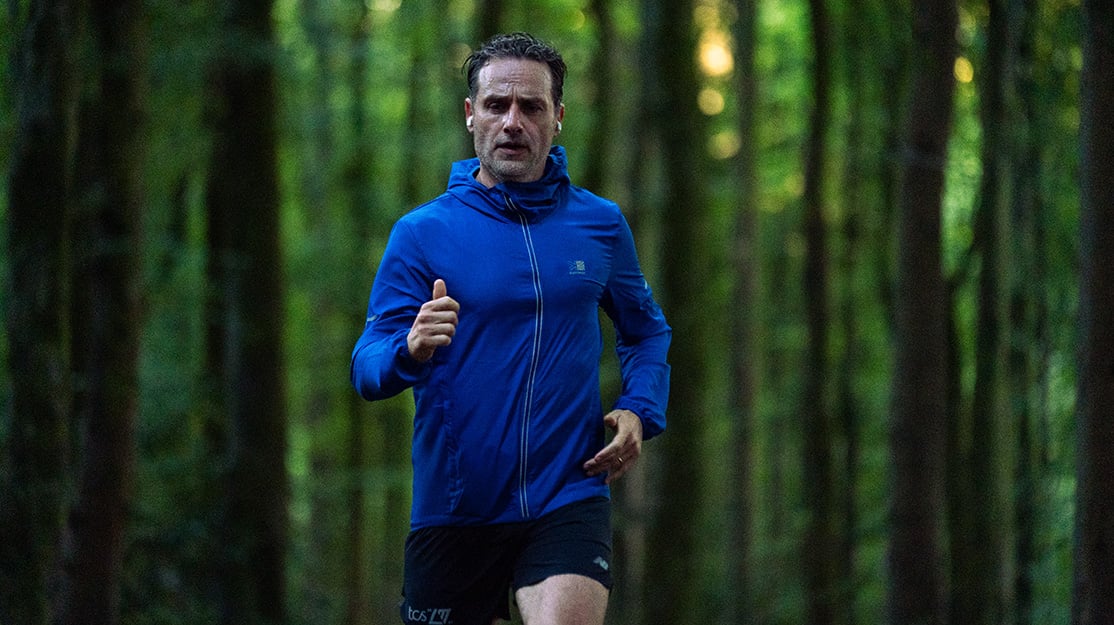
Making his return to British television, The Walking Dead star Andrew Lincoln plays John, a repressed man who is shocked to find himself in middle age, secretly raging at his life as a stay-at-home dad. When his failure to intervene in a violent confrontation in a playground brings his identity crisis to a head, John ups and moves his family to the rural Scottish idyll of Coldwater.

Upon arrival, John is quickly befriended by next-door neighbour Tommy (Ewen Bremner), a charming, confident man and devoted husband to the local vicar Rebecca (Eve Myles). But John’s wife Fiona (Indira Varma) believes Tommy isn’t all he appears to be.

When John’s long-repressed rage comes to the surface with disastrous results, he soon finds himself unexpectedly indebted to his new friend, unaware that Tommy himself is harbouring horrifying secrets and leading him to wonder who his new friend actually is.

Northern Irish writer Ireland describes John as an “everyman,” a normal guy who finds himself in a desperate situation. While he and Fiona are running away from the problems in their marriage, he is also running away from a violence inside him.

“When he moves to Coldwater and befriends Tommy, Tommy sees something in him. That’s when he connects with this inner violence and an inner masculinity that he’s been denying in himself,” Ireland says. “But he’s just a normal guy that finds himself in an extraordinary situation.”

That rage inside John has been suppressed through circumstances in his life and marriage, and has been held back while he lived in London. “He can’t bring it out in the middle-class world he lives in,” Ireland continues. “That stuff really comes out when he’s in the woods. Andrew described it as a story of a man who runs into the woods and encounters a demon. That’s basically the story of the whole thing.”

Coldwater is also an exploration of male friendship, as John is a character who doesn’t have a lot of friends. “I think that’s quite common with a lot of middle-aged men,” Ireland observes. “I’ve noticed this with other middle-aged men that, once we’re settled, we’re not in the market for new friends. Most middle-aged men I know have the same friends they had when they were nine or 10 years old. But he doesn’t really have anyone when he moves to this community, and he doesn’t have any real friends in London.”

Andrew Lincoln returns to British television in ITV thriller Coldwater

Tommy then becomes the first real friend John has had in years, though he’s seemingly the complete opposite. “He seems like he has his life together,” Ireland says of Bremner’s character. “He seems really comfortable in his own skin. He hunts and he takes part in traditional male activities that John has never taken part in – and he introduces John to that world. He goes out to the pub drinking with a group of guys. John doesn’t do that. In John’s eyes, he’s the perfect best friend and the perfect neighbour. But obviously, things don’t stick.”

Ireland describes casting Lincoln as a “dream come true,” and the actor’s executive producer role meant he was heavily involved in the production, offering numerous ideas about John.

“He’s just really good at working with writers and working with other actors, and he was really able to help me shape it and [offer] his thoughts about the character,” Ireland says. “He was really heavily involved in the development of the character and the whole series. His help was invaluable.”

Coming from a theatre background, Ireland says the world of TV “is all quite new to me” and that he didn’t know what to expect creating his own series. He previously wrote episodes of BBC series The Young Offenders.

What surprised him most was that TV “is completely the director’s vision,” he says. “As a writer, you can lead them with the script but, ultimately, the audience sees things from the director’s point of view. Whereas in theatre, the audience always sees things from the playwright’s point of view.

Lincoln’s John and his wife Fiona (Indira Varma) move their family from London to rural Scotland

“But I don’t mind that, especially if you’ve got a good director.” On Coldwater, Lee Haven Jones (A Cruel Love: The Ruth Ellis Story) and Andrew Cummings (Shetland) shared directing duties and took on Ireland’s hopes of creating a show in the style of films by Quentin Tarantino or the Coen Brothers.

Those filmmakers speak to Ireland’s own inspirations for Coldwater. He is a fan of any kind of horror or thriller set in a rural environment, especially when someone from the city moves to the countryside, like in Straw Dogs and Eden Lake.

“Visually, it looks really good. I really like the look of it,” he says. “Lee really took that [idea] on board and there are moments that are very Tarantino-esque, which is great fun to watch. They really took that and ran with it.”

The Lovers and Coldwater also reflect Ireland’s love of romantic comedies, thrillers and horror. “My two favourite films are When Harry Met Sally and The Texas Chainsaw Massacre, so I’m always bouncing between one genre and the other,” he says. “It was fun to be writing The Lovers during the day and then writing Coldwater at night. It was two very different worlds.”

Ireland admits he finds writing for TV a challenging prospect, noting that while a play might be about one story and one theme, with a limited number of characters, television is much more expansive, especially when you have six hours of screentime to fill.

The couple’s next-door neighbours are Rebecca (Eve Myles) and Tommy (Ewen Bremner)

“Most of my plays only have two or three characters. To have 10, 11, 12 characters feels impossible,” he says. “That’s always been my reservation about writing for television. But when you have good producers working with you, it makes it a lot easier.” Coldwater is produced by Sister, with Jane Featherstone, Alice Tyler and Lydia Hampson among the executive producers. ITV Studios is handling distribution.

“With The Lovers, there were a few other characters but that was mainly about these two characters, and I felt frustrated at my own writing that it didn’t feel very visual to me,” he says. “I didn’t want to do that with Coldwater. I wanted to write something that actually feels like a TV show, that doesn’t feel like you could just do it as a play on stage. So from the first episode, my intention was to think more cinematically, more visually and try to make it more expansive, and make it more of a world.”

That the story is not just about John and Tommy, but Rebecca and Fiona too, means Coldwater naturally has different relationships to explore.

“If you want really good actors, you have to make those roles interesting, so instead of being just generic wife characters, they became equally as fascinating as John and Tommy,” Ireland says. The show then became a portrait of two marriages, rather than just about a male friendship.

“It’s a marriage between John and Fiona, who are very good, decent people, but their marriage is falling apart. And then you’ve got Tommy and Rebecca, who are not good people. One could actually call them evil, but their marriage is very happy. They adore each other. So it’s a portrait of two marriages in that way.”

John finds himself indebted to Tommy after his long-suppressed rage boils over

Continuing the Tarantino theme, Ireland initially imagined the series ending in a “bloodbath.” But as he wrote the scripts, the story changed dramatically. In fact, he was still writing the final scripts as filming began – only two were in place when the series was greenlit – so he was able to lean into the performances from his cast as he watched the series being filmed.

Ireland wasn’t a regular presence on set, however. “I hate being on set. I really despise it,” he says. “I try my best to stay far away from set. I’ve been an actor for years and played small parts in TV shows, and even if you’ve got one or two lines, you feel like you’ve got a purpose. You feel like you’ve got a reason to be there, and everybody treats you like you’re important. As a writer, I’m like, ‘What am I doing here?’ There’s no point. I don’t really contribute anything. My job’s done. I feel like I was just getting in the way of people doing more important jobs.”

One of the reasons he did write Coldwater, however, was to create a series that could be filmed in or around Glasgow, closer to his home. He also has a cameo in episode four.

“I thought, ‘Then I’ll be able to go to the set every day and sit there with my coffee.’ But it didn’t work out like that. I cannot stand being on set. People want me to be on set, people want me to look at scenes and I’m like, ‘No, I’ll just do it from my house.’”

Now the show is set to make its debut, Ireland hopes audiences will be thrilled by John’s story. “The worst thing that you can do to an audience is bore them,” he says, “so I hope there’s something interesting in every scene.”


Like that? Watch this! Suggested by AI, selected by DQ

Broadchurch: When a young boy is found murdered in a small Dorset town, two mismatched detectives are forced to dig into secrets the locals want left buried, ripping the close community apart.

The Moorside: In a Yorkshire estate, the disappearance of a young girl throws neighbours into turmoil as the search uncovers lies, complex relationships and questions of trust within a small community.

Blood: A woman returns to her rural Irish home after her mother’s death and soon suspects her own father may be concealing a deadly secret.

tagged in: , , , , ,